Share


In most companies, fixed assets accounting documents create significant burden on accounting and operational departments. Asset commissioning, disposal, and transfer records require 3 to 10 signatures: commission members, director, chief accountant, and personnel responsible for acceptance and handover. Even in smaller companies, the volume of such documents reaches dozens per quarter; in large organizations — hundreds.
e-Docs Platform is a comprehensive platform for automating document-oriented business processes that unites teams and processes in a single document management center. The platform covers the full spectrum of corporate processes: from accounting and contract management to HR administration and procurement, ensuring continuity across the entire organization.

Systemic Problems in Traditional Processes
The typical process for handling fixed assets accounting documents involves several sequential stages. The accountant generates a document in the accounting system, prints it, after which the document goes through sequential signature collection: commission members, responsible persons, chief accountant, director. The absence of any signatory from their workplace halts the entire process.
The result is accumulation of significant volumes of unsigned documents. Implementation experience reveals situations where documents remain unsigned for extended periods due to changes in signatories, business trips, vacations, or employee departures.
Specifics of Fixed Assets Accounting Documents
Fixed assets accounting documents have a fundamental difference from other categories of corporate documents. Unlike contracts, where approval procedures are determined by company internal policy, or HR documents, where each organization establishes its own processing rules, accounting documents for fixed assets are regulated by legislation.
Asset commissioning, disposal, and transfer records are generated according to established forms approved by regulatory acts. Requirements for signatory composition and execution procedures are clearly defined. This standardization creates prerequisites for structured automation implementation.
Solution Based on e-Docs Platform Integration
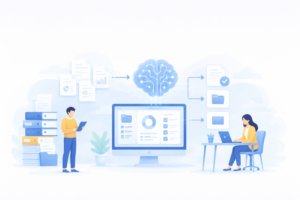
e-Docs Platform provides fixed assets accounting automation through integration with the enterprise’s accounting system. The platform serves as a unified center where all process participants converge — from accountants to commission members and management.
The process functions as follows:
The accountant creates a document in the accounting system. Automatically, without additional actions, the document is transmitted to e-Docs Platform and sent for signing to relevant persons according to the configured route — in parallel or sequentially.
Signatories receive notifications and can process documents through web interface or mobile application at a convenient time, regardless of location. The platform ensures complete process transparency: at any stage, one can determine the current document status, list of persons who have already signed, and those currently processing it.
Universal Mechanism Without Reconfiguration
e-Docs Platform implements a universal routing mechanism that requires no adjustment for each individual document. If today an act is signed by one commission composition, and tomorrow by another, the platform automatically adapts to changes in organizational structure without requiring process reconfiguration.
The platform provides flexible signature route construction:
- Sequential processing — document advances to the next signatory only after completion of the previous stage
- Parallel processing — document is simultaneously sent to a group of persons
- Combined schemes — combination of sequential and parallel stages according to process requirements
The system allows setting regulatory timeframes at each processing stage with automatic reminders. Signatories receive notifications about approaching deadlines, ensuring compliance with established timeframes without manual control.
Autonomous Scenario Without Integration
e-Docs Platform supports implementation even without integration with the accounting system. In this case, the accountant uploads documents directly into the platform and configures the signature route. Although this approach requires additional manual operations, the platform still significantly accelerates the process and ensures execution control.
According to implementation experience, even companies that initially lacked technical capability to implement integration noted significant improvement in document workflow. The primary value for them was the ability to guarantee that documents are signed and store them in structured form with complete processing history.
Implementation Experience
Based on completed projects, companies note the following changes:
In a retail network over three months, 4,000 fixed assets accounting documents were processed. The critically important fact was that all documents received necessary signatures within established timeframes, whereas previously a significant portion of documents remained unsigned for extended periods.
Companies note reduction in physical paper archive volume, as the need to print documents for signature collection disappears. Documents are stored electronically with legally significant electronic signatures.
Technical Implementation Prerequisites
Implementing fixed assets accounting automation requires compliance with several conditions:
- Use of document forms approved by legislation
- Determination of signatory composition in accordance with regulatory act requirements
- Integration configuration with accounting system (optional but recommended)
- Provision of qualified electronic signatures to signatories
Implementation is carried out within timeframes from two weeks to two months depending on accounting system integration complexity and number of processes subject to automation.
Legal Aspects
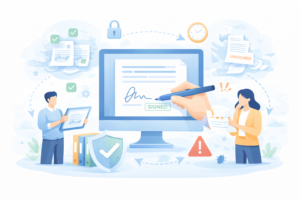
According to Ukrainian legislation on electronic trust services, a qualified electronic signature has the same legal force as a handwritten signature. This ensures complete legitimacy of documents signed through e-Docs Platform.
The platform allows configuring the process such that a document reaches the next participant for signing only after completion of the previous stage. For example, the director receives a document for signing only after it has been signed by all commission members and responsible persons. This logic excludes situations where a document is signed in violation of established sequence.
Impact on Work Organization
Fixed assets accounting automation affects work organization for several employee categories:
The accounting department gains the ability to focus on analytical and accounting functions instead of coordinating signature collection processes. Predictability of document processing timeframes increases, which is critical for meeting reporting periods.
Signatories process documents without being tied to workplace or working hours. This is particularly relevant for executives who spend significant time on business trips or in meetings.
The organization as a whole obtains a structured document database with complete change history, which simplifies preparation for inspections and audits.
e-Docs Platform: Unified Company Document Management Center
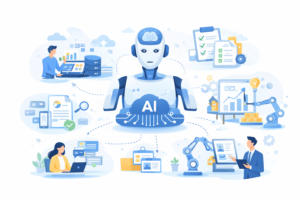
Fixed assets accounting automation is just one direction covered by e-Docs Platform. The platform provides comprehensive automation of all document-oriented company processes:
- Accounting documents and primary documentation
- Contract activities and contract management
- Procurement and tender procedures
- HR administration
- Internal administration and directive documentation
All processes are unified in a single space, allowing the company to function as a coordinated organism. Documents from different departments interact with each other, data is automatically transferred between processes, and management receives a complete picture of organizational activities in real time.
This centralization provides not just automation of individual processes, but comprehensive transformation of the company’s work method — from chaotic paper document flow to an organized digital ecosystem where each process is transparent, controlled, and optimized.
Obtain Consultation on Fixed Assets Accounting Automation in Your Company
The e-Docs team has over 15 years of experience implementing electronic document management systems in Ukrainian companies. We possess expertise in national legislation specifics, primary document execution requirements, and practical aspects of accounting department operations.
For detailed information on fixed assets accounting automation capabilities in your organization, contact our specialists.