Share


Deloitte has released its annual Tech Trends report, focusing on agentic artificial intelligence and its impact on enterprise operations. The report’s central finding: companies that automate legacy processes without rethinking them fail to achieve transformation—fundamental operational redesign is required.
We analyzed the report through the lens of electronic document management and identified several critical trends that will shape the industry in the coming years.
From Automation to Process Redesign
Deloitte фіксує проблему: більшість компаній не бачать значущих результатів від впровадження агентного ШІ. Причина — вони цифровізують існуючі процеси без їх пDeloitte identifies a persistent issue: most companies see limited results from agentic AI implementation. The reason is straightforward—they digitize existing workflows without questioning their underlying logic.
“Many organizations have yet to see meaningful transformation from agentic AI because they’re simply automating existing processes rather than fundamentally reimagining their operations”
For document management, this means: migrating paper-based approval routes to electronic systems isn’t enough. Organizations need to revisit the fundamental logic—which approval stages are necessary, which decisions can be delegated to agents, how to optimize the sequence of actions.
Leading companies design processes with AI capabilities in mind from day one, rather than retrofitting artificial intelligence onto existing architectures.
Paradigm Shift: From Documents to Data and Context
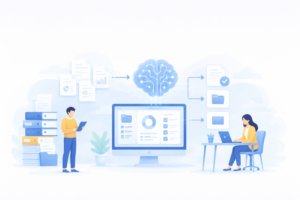
Deloitte emphasizes a fundamental change in how information is managed. Agentic AI systems don’t process documents as files—they require structured data, context, and relationships between entities.
Deloitte draws a parallel to the evolution of internet search: the transition from file archives to enterprise-wide indexing, similar to how Google operates.
Practical implications for document management systems:
- Vector databases instead of file repositories
- Natural language queries instead of metadata search
- Knowledge graphs to understand relationships between documents, events, and decisions
Modern document management platforms are evolving from storage and routing systems to intelligent platforms for managing corporate knowledge.
Agent Architecture: The “Silicon Workforce”
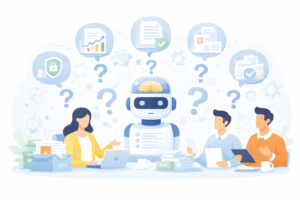
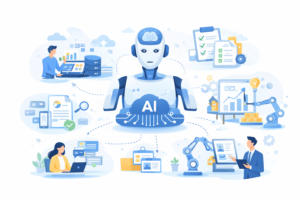
Deloitte introduces the term “silicon workforce”—AI agents as full participants in business processes that complement human capabilities.
In document management context, this means functional distribution:
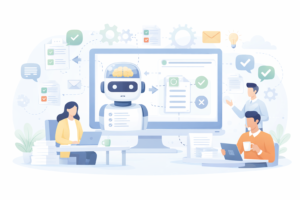
- Agents perform compliance checks, analyze risks, monitor deadlines, and prepare document drafts
- Humans make decisions in non-standard situations and retain responsibility for strategic and legally significant actions
According to Deloitte data, only 11% of organizations actively use agentic AI in production, despite 38% having pilot projects. The primary obstacle: processes weren’t designed for agent-based systems.
Hybrid Infrastructure as Standard
The report documents an important trend: moving away from the universal “all-cloud” approach. Despite compute costs dropping 280-fold over two years, large enterprises are paying tens of millions of dollars monthly for AI services in public clouds.
Deloitte recommends strategic hybrid architectures:
- Cloud services—for variable workloads and experimentation
- On-premise infrastructure—for predictable production operations
- Edge computing—for latency-critical processes
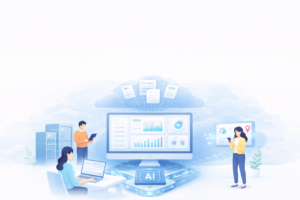
For enterprise document management systems, this means supporting different deployment models based on client requirements for data control, cost, and performance.
Security as Architectural Foundation
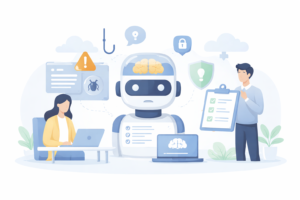
Deloitte highlights the paradox: AI simultaneously strengthens business capabilities and creates new risks.
“AI creates a cybersecurity paradox: the same capabilities driving business innovation also create new vulnerabilities”
Key threats in document management:
- Confidential data leakage through agents to public LLM services
- “Shadow AI”—employees using public tools for corporate documents
- Uncontrolled autonomous agent decisions
Deloitte emphasizes the “security by design” principle—security must be embedded in the architecture from the start, not added later. Every agent action requires verification and logging.
Application Limitations
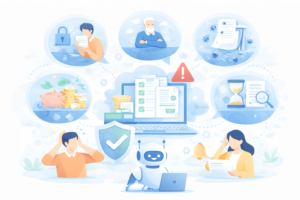
Complex document automation systems with agent capabilities aren’t suitable for all organizations.
The system won’t solve the problem when:
Formalized processes don’t exist—automating chaos creates digital chaos.
Low digital maturity of personnel—implementation will require significant investment in training and organizational culture change.
Unrealistic expectations about AI autonomy—agents are effective for structured, repetitive tasks but don’t replace expert judgment in complex, non-standard situations.
Scale mismatch—for smaller organizations with simple document workflows, basic exchange tools are sufficient.
Practical Conclusions
For companies considering implementation or modernization of document management systems:
Process audit should precede technology selection. The question isn’t which system to choose, but how processes should function after optimization.
Architectural flexibility matters more than feature lists. Key criteria: agent integration capability, support for different deployment models, open APIs for enterprise system integration.
Security must be part of the architecture, not an additional layer.
Partner matters more than vendor—document management transformation requires rethinking the operational model, demanding expertise in both processes and technology.
Conclusion
Deloitte states it clearly: organizations built for incremental improvements cannot compete with those operating in continuous learning mode.
Companies designing document management systems as platforms for agents will achieve exponential separation from competitors—not 10-20% optimization, but order-of-magnitude efficiency gains.
e-Docs Platform implements these principles: built on Microsoft 365 with embedded AI functions for contract analysis and process automation, ensures closed-loop document circulation (internal and external), integrates with ERP/CRM systems, and is ready for AI agent deployment.
Over 15 years, we’ve implemented 90+ projects for Ukrainian enterprise companies. Our experience confirms Deloitte’s conclusion: document management transformation isn’t about implementing technology—it’s about reimagining how companies make decisions and manage information.