Share


Although electronic document management (EDM) has become the standard for most forward-thinking companies, outdated stereotypes still linger in the market—slowing down digital transformation. Ironically, these misconceptions often come from organizations that, due to their scale and structure, have already lost visibility, speed, and control over their internal processes.
In this article, we debunk six of the most common myths we hear during consultations with clients. And we explain why modern EDM isn’t just about “signing documents online”—it’s about rethinking your internal workflows, regaining control, enabling scale, and ensuring legal security.
Myth 1: “EDM is just PDF files sent by email”
This is one of the most persistent misconceptions. If you’re sending files to colleagues and they apply an e-signature in some app, that doesn’t mean you’re running an electronic document management (EDM) system. That’s simply a digital version of a manual process.
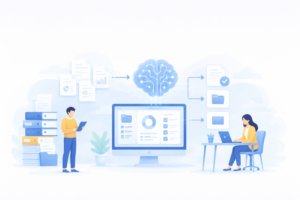
A true cloud-based document management system is something entirely different. In a full-scale EDM platform like e‑Docs, documents go through their entire lifecycle: creation, review, approval, signing, storage, and audit. Each step is automated, controlled, and fully traceable.
Thanks to integration with Microsoft 365, users can work within familiar tools like SharePoint and Teams. Single Sign-On (SSO) eliminates the need for constant logins, and the platform manages workflows with built-in routing, deadlines, roles, and access levels.
Myth 2: “EDM systems are only for legal or accounting teams”
This belief dates back to the early days of electronic document management, when it was used mostly for financial reports or legal acts. But modern, user-friendly EDM platforms are built for the entire organization — including HR, procurement, finance, logistics, project management, office admins, and even the CEO.
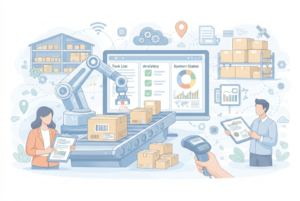
EDM often starts with something simple — like approving travel requests — and then scales across the company: from digital HR records to budget approvals, KPI tracking, invoices, and contracts. The system supports complex, cross-functional workflows involving dozens of roles — and each user sees only what’s relevant to them. No more email chaos or scattered approvals.
Myth 3: “EDM systems can be hacked by competitors or cybercriminals”
In reality, modern cloud-based systems are far more secure than most on-premise archives or paper-based storage. For example, e‑Docs.Platform is built on Microsoft Azure infrastructure and complies with international cybersecurity standards. All documents are transmitted via encrypted, secure channels.
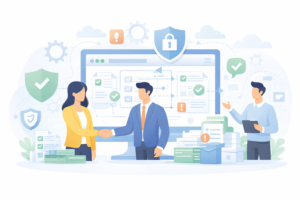
Security measures include multi-factor authentication, role-based access controls, detailed activity logs, audit trails, and automatic backups. Every action is tracked. That’s why electronic document management is often more secure than sending files by email or carrying printed folders through the office.
Myth 4: “Electronic documents have no legal value”
This is one of the most dangerous misconceptions. In fact, since 2003, Ukraine has had legislation recognizing the legal force of electronic documents — including the Law on Electronic Documents and Electronic Document Management, and the Law on Electronic Identification and Trust Services. The Ukrainian Civil Code clearly states: a document signed with a QES (Qualified Electronic Signature) holds the same legal weight as one signed by hand.
A QES is a special type of electronic signature based on a qualified public key certificate issued by an accredited trust service provider. It offers the highest level of legal trust and is fully recognized under Ukrainian law.
At e‑Docs.Platform, we support not only QES-based signing but also full audit trails, version tracking, signer verification, and change control. This level of transparency is essential for compliance and legal protection. In fact, our clients’ legal teams often confirm that a properly audited digital document has stronger evidentiary power than a printed one that can be lost or damaged.
Myth 5: “The tax office requires paper documents”
No, it doesn’t. Ukrainian legislation does not require companies to provide paper copies during audits. If your documents are signed with a Qualified Electronic Signature (QES) and properly formatted, the tax authority or any other regulatory body will accept them in digital form.
In real cases with e‑Docs clients, companies have passed tax audits by submitting digital extracts from approval logs and signed electronic copies — without printing a single page. That was more than enough. Why? Because when contracts, invoices, delivery notes, and internal orders are managed in a centralized, traceable system, the entire history is recorded in secure logs — and that’s exactly what auditors need.
Myth 6: “We’re not ready because our processes aren’t perfect yet”
This is one of the most misleading myths. Many companies postpone implementation because they think, “We need to fix everything manually first.” But implementing e‑Docs.Platform is actually the path to fixing it. We don’t just “turn the system on” — we dive into your real workflows, identify bottlenecks, help you define logic, build routes, and automate everything step by step.
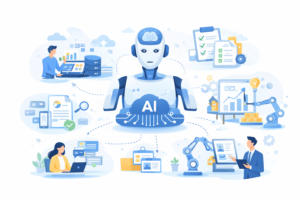
With AI-powered automation, e‑Docs doesn’t just replicate what you had on paper — it helps rethink the entire structure: eliminate duplication, shorten approval chains, automatically track SLAs, send reminders, and streamline decision-making. Even companies with the most chaotic processes can start small and see results fast.
And most importantly: electronic document management isn’t just about “less paper.” It’s about true optimization. e‑Docs is a consulting-driven team that works with you to understand your actual operations, configure processes for your needs, and integrate the right tools — not force off-the-shelf solutions.
That’s why we don’t just talk about e-signatures. We help build a fully integrated ecosystem with Microsoft 365, SharePoint document management, AI-powered EDM, online HR workflows, and centralized contract lifecycle management.
Want to see where your digital transformation journey can begin? Just reach out — and we’ll show you what real business process optimization looks like.