Share


In our experience working with large enterprises, we repeatedly encounter the same challenges: slow document approval processes, duplicated actions, lack of transparency, wasted time, and human error. In most cases, these issues stem not from people, but from the absence of modern tools for processing information.
Today, business process automation is nearly impossible without the integration of artificial intelligence. Document management is one of the areas where AI has already proven its value. In this article, we’ll explore how AI-powered document workflows work, how to implement them effectively, and what advantages they bring to organizations with complex, multi-level structures.
Why traditional document management doesn’t scale
In many large companies, processes related to contracts, invoices, and internal memos still happen in a fragmented, hybrid format — part in Excel, part via email, part handled manually by different departments. At scale, this creates critical risks:
- Lack of transparency. The status of a document can remain unclear for days, especially in cross-functional approvals (finance–legal–management).
- Duplicated actions. Data from a contract is manually entered into a CRM, then into the accounting system, then into BI reports.
- High workload. Employees spend dozens of hours approving repetitive, template-based documents.
- Errors and risks. Human mistakes often lead to critical inaccuracies in documents.
- Costly delays. Every day an invoice or contract is stalled could mean lost revenue or a blocked delivery.
Implementing electronic document management systems (EDMS) addresses many of these issues — but without AI, bottlenecks still remain. That’s why e-Docs incorporates intelligent document processing powered by machine learning, computer vision, and natural language understanding.
The role of AI in document automation: not just a process, but a strategic asset
Unlike traditional document management systems that merely store files and track statuses, artificial intelligence transforms document workflows into controlled, predictable, and self-analyzing systems. This shift is enabled by:
- Optical Character Recognition (OCR) for automated text extraction
- Automated Content Recognition (ACR) for contextual understanding of document structure
- Decision support to guide approvals and routing
- Automated workflow scenarios based on business logic
- Performance monitoring through real-time KPIs
- Deviation and risk analytics powered by tools
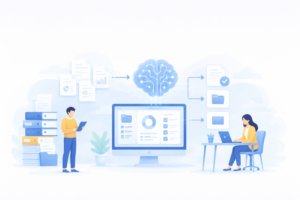
Data extraction from documents
What is OCR / ACR and how do they differ?
- OCR (Optical Character Recognition) is a foundational technology that extracts text from PDFs, scans, and images. It’s the first step in digitizing documents that were previously handled only on paper.
- ACR (Automated Content Recognition) goes further. It interprets not just characters, but the meaning and structure of a document. ACR identifies key fields such as total amounts, counterparties, and dates, detects the document type, and applies the appropriate routing logic automatically.
The e-Docs system is integrated with Azure Cognitive Services, specifically Form Recognizer, which enables:
- automatic processing of invoices, contracts, and statements
- data extraction without human intervention
- dynamic document structuring based on extracted values
- seamless data transfer to internal accounting and management systems
Intelligent automation: templates, triggers, and RPA
In AI-powered document management systems, the success of implementation heavily depends on how well the sequence of actions is configured. In e-Docs, this is achieved through:
- Document templates — preconfigured with structure, required fields, and approval workflows tailored to the organization’s processes, approval hierarchies, exceptions, and industry-specific requirements. These are not static forms but dynamic models that evolve with the client’s business and are configured collaboratively.
- Event-based triggers — for example: if an invoice exceeds 100,000 UAH → automatically add the CFO to the approval chain.
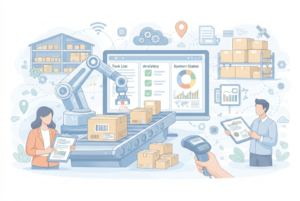
- RPA (Robotic Process Automation) — execution of tasks without user involvement: transferring data, creating records in CRM or ERP systems, triggering tasks in Teams.
These tools significantly reduce team workload, speed up document approval times by 30–60%, and minimize manual effort across the process.
AI-Assistant — your digital co-pilot for document workflows
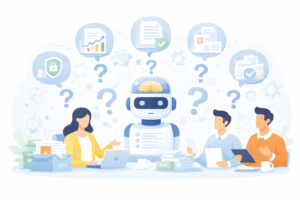
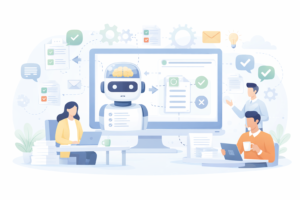
The e-Docs system features an AI-powered assistant — a specialized digital helper that leverages machine learning models, computer vision, and natural language processing. Its capabilities include:
- Recognizing unstructured document text
- Importing documents from multiple channels
- Auto-filling data from ERP, CRM, and SharePoint, with consistency checks
- Extracting key details (counterparty, date, amount)
- Validating document language against legal and internal policies (e.g., checking references and document validity)
- Providing intelligent search and step-by-step user instructions
- Suggesting approval workflows based on historical patterns
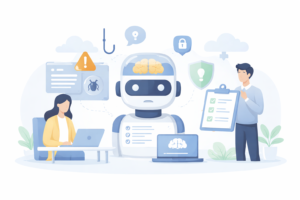
- Detecting risks, duplicated content, and inconsistencies
- Verifying consistency across related documents
- Identifying sensitive or confidential information in files
This isn’t a separate interface — it’s embedded intelligence that lives throughout the entire system. It supports every stage, from document import to final approval. The AI assistant doesn’t replace employees — it handles the repetitive tasks that would otherwise take hours of manual effort. The result: faster workflows, higher compliance, and less time spent on routine actions.
Decision support: analytics, insights, and control
When a document management system doesn’t just store files but actually analyzes them — it becomes a true business tool.
- Intelligent suggestions, such as highlighting risks in contracts (deviations from standard terms, missing clauses, altered wording, or exceeded limits)
- Automated alerts for critical values — amounts, deadlines, or conditions
- Approval performance reports that show bottlenecks and efficiency
- KPI dashboards: processing time, share of “approved without edits” templates, SLA compliance, number of escalations or returnsрнень).
This empowers leadership to view processes by timeline, responsible teams, and overall impact on business performance.
Integration with Azure Active Directory
For organizations working with sensitive data or operating under strict compliance requirements, e-Docs offers seamless integration with:
- SSO (Single Sign-On) via Azure AD
- Role-based access control at the document, department, and category levels
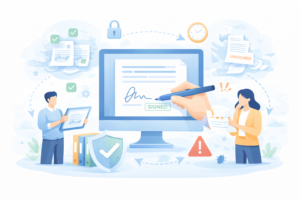
- Audit trail — a complete change history aligned with audit standards
- Automated notifications via Outlook
Every project has its own dynamics, but the outcome remains consistent: control, efficiency, and transparency.
AI in document workflows is no longer the future — it’s now
There are countless cases where companies have poured huge budgets into staffing and manual operations, while the real solution was smart automation.
Today, artificial intelligence in business process automation is no longer niche or experimental. It’s a critical management tool that enables speed, flexibility, compliance, and scalability.
The e-Docs platform is more than just software — it’s a fully integrated solution that helps large enterprises build a unified digital document ecosystem, tailored to their structure, workflows, and business goals.
If you’re exploring how to implement AI-powered document management in your organization, reach out — our team will assess your current processes and provide a personalized automation roadmap.